Airline goes bust: what happens to your ticket, refund and compensation
Friday, November 27, 2026
When an airline goes bust, what happens to your ticket depends on two things: whether the airline is restructuring or has entered formal bankruptcy, and how you paid. An airline that is negotiating with its creditors still owes you a refund and any compensation. Once it is formally bankrupt, those claims join a long queue, so your card provider, travel agent or package organiser is usually the faster way to get your money back.
2026 has shown both sides. Soaring jet fuel prices pushed several airlines over the edge: Norse Atlantic suspended all flights on 26 November and said it would file for bankruptcy unless it found urgent funding, Spain's Plus Ultra stopped flying while negotiating with its creditors, and airBaltic kept flying through a US Chapter 11 restructuring.
What happens when an airline goes bust? The short answer
| Situation | Your flight | Refund and compensation |
|---|---|---|
| The airline is restructuring and still flying (for example Chapter 11) | Your ticket stays valid and flights usually operate | Owed and normally paid as usual |
| The airline is negotiating with creditors but has stopped flying | Flights are cancelled | Still owed, but payment can be slow or uncertain |
| The airline is in formal bankruptcy or liquidation | Flights are cancelled for good | They become creditor claims: usually only part of the money, or nothing |
| You booked a package holiday | The organiser must find another flight or refund you | Protected by the organiser's insolvency protection |
What happens to my booking when an airline goes bust?
If the airline keeps flying, nothing changes for you: your booking stands and you fly as planned. If it stops flying, every flight it was due to operate is cancelled, usually with little or no notice. The airline should tell you, but in practice many passengers find out from the news or at the airport.
A cancelled flight normally gives you the choice between a full refund within seven days and an alternative flight. An airline that has stopped operating can't offer you another flight on its own aircraft, and it may not have the cash to pay refunds either. That is why it matters so much whether the airline is restructuring or truly bankrupt.
If your flight was operated by a different airline than the one you booked with, check who actually flies it. Under passenger rights law, the operating airline is responsible for the flight, so a flight operated by a healthy airline may go ahead even if the airline that sold you the ticket is in trouble.
Restructuring or bankruptcy: why the difference matters
"Going bust" covers very different legal situations, and they lead to very different outcomes for passengers.
- Restructuring with the airline still flying. Under US Chapter 11, a company keeps operating while it reorganises its debts under court supervision. airBaltic filed for Chapter 11 in New York on 14 September 2026, and the court allowed it to keep honouring tickets, refunds and vouchers as normal. On 26 November 2026, Latvia's parliament voted to allow a state guarantee of up to €175 million so the airline can draw more financing.
- Pre-insolvency talks. In Spain, a company can tell the commercial court it has opened negotiations with its creditors, which gives it a few months of protection to agree a restructuring plan. Plus Ultra did this on 13 November 2026 and suspended all its flights from 23 November.
- Formal bankruptcy or liquidation. A court opens insolvency proceedings and an administrator takes over. If there is no rescue, the airline is wound up, its assets are sold and the money is shared among its creditors.
As long as an airline is negotiating with its creditors, it still has to refund cancelled tickets and pay the compensation passengers are owed. But if the airline goes into formal insolvency, those claims join the queue with other creditors, and passengers usually get back only part of their money, or nothing. That's why we advise anyone who paid by card or booked a package holiday to try those routes first, and to keep every email and receipt.
How to get your money back: three routes to try first
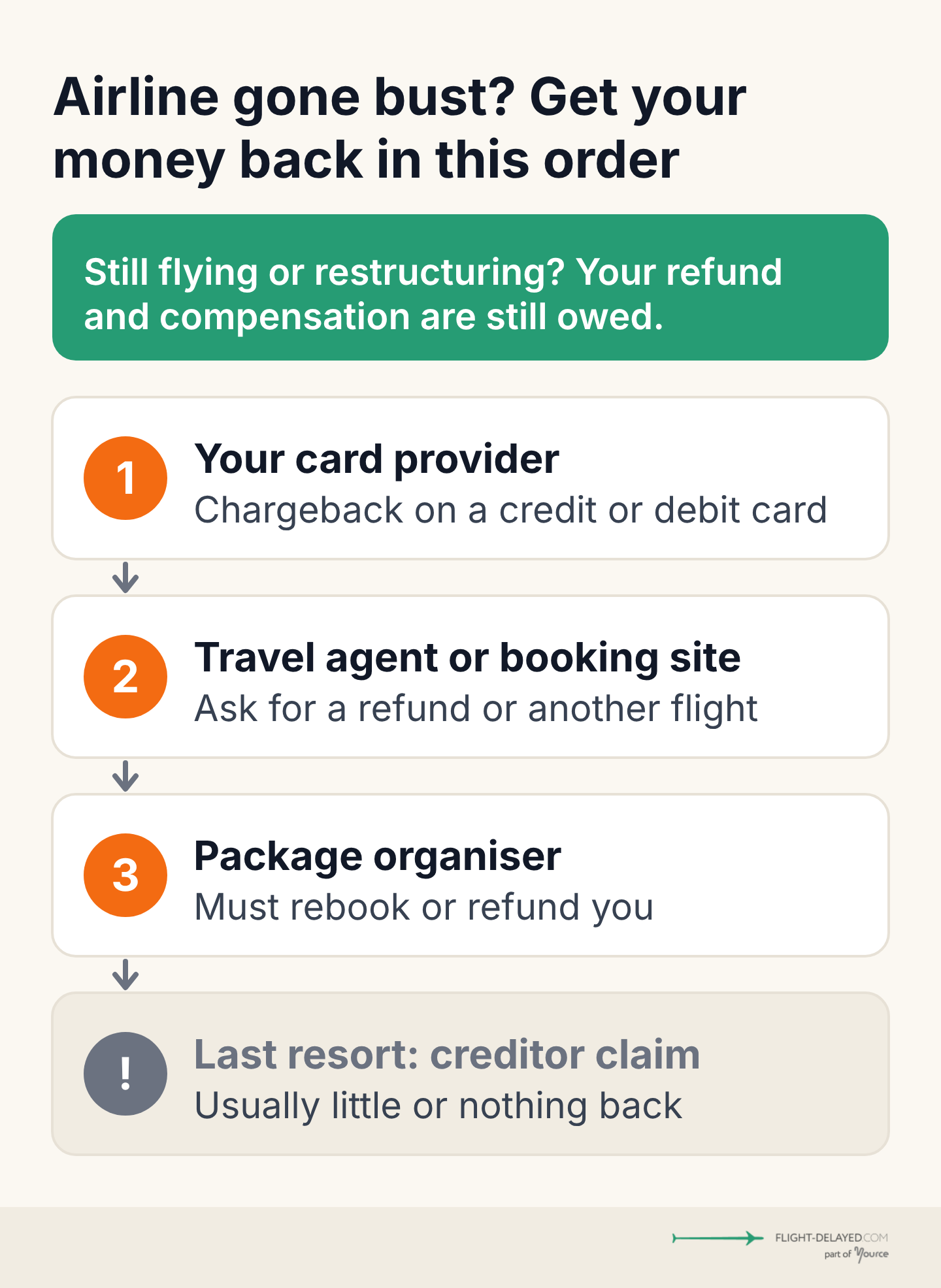
1. Your card provider
If you paid by credit or debit card and the flight won't happen, your bank may be able to reverse the payment through a chargeback. This is a card scheme rule (Visa, Mastercard, American Express), not a legal right, and it has time limits, so it's worth asking your bank early.
In the UK, paying the airline directly by credit card gives you extra protection under Section 75 of the Consumer Credit Act 1974. Your card provider is jointly responsible with the airline for tickets costing more than £100 and up to £30,000, including when the airline goes bust.
2. Your travel agent or booking site
If you bought a flight-only ticket through a travel agent or booking site, ask them what they can do. Some agents refund customers or rebook them on another airline, especially if they paid the airline themselves with a card or are part of a protection scheme. If the agent took your card payment, the chargeback route above still applies to them.
3. Your package organiser
If your flight was part of a package holiday (a flight plus a hotel or other travel service sold together), you are in the strongest position. Under the EU Package Travel Directive, the organiser is responsible for the whole trip: if the airline collapses, it must find you a suitable alternative or refund you. Organisers must also have insolvency protection, which covers getting you home if you are already travelling. In the UK, packages that include a flight are ATOL protected.
Some booking sites and airlines also sell insolvency protection together with the ticket. If you bought it, it covers exactly this situation, so check your booking confirmation.
What happens to compensation if the airline goes bust?
Your rights under EU261 don't disappear when an airline gets into financial trouble. A flight cancelled less than 14 days before departure, or a delay of three hours or more at your final destination, can still give you a right to compensation of up to €600 per passenger. Financial problems are the airline's own business risk, so they generally don't count as an extraordinary circumstance.
The real question is whether the airline can pay. During a restructuring it usually still does. In formal bankruptcy, compensation claims become ordinary creditor claims, just like unpaid refunds. Passengers rank behind secured creditors and many others, so the share they receive at the end of the proceedings is usually small, and it can take years.
This also applies to compensation you were already owed before the airline collapsed, for example for a delay earlier in the year. If the airline is formally bankrupt, that claim goes into the same queue.
Stranded abroad: getting home when your airline stops flying
If you are abroad when your airline stops flying, the airline is unlikely to arrange another flight or pay for meals and hotels, even though the rules normally require it. Here is what usually helps:
- Package holiday: your organiser must bring you home at no extra cost. Contact them first.
- Rescue fares: when an airline collapses, other airlines sometimes offer discounted "rescue" or "repatriation" fares to stranded passengers on the same routes for a limited time. Check the websites of airlines flying your route.
- Booking a new flight: if you have to buy a new ticket home, keep the booking confirmation and receipts. Depending on how you paid for the original flight, your card provider may be able to help with the original ticket.
Delayed or cancelled with an airline that's still flying?
Most delays and cancellations have nothing to do with bankruptcy, and airlines that are restructuring still have to follow the rules. Under EU261, the airline must give you meals and drinks from a delay of two hours, and a hotel if you have to wait overnight. If you arrive at your final destination three hours or more late, or your flight is cancelled less than 14 days before departure, you may be entitled to compensation of €250, €400 or €600 per passenger, depending on the distance. The exception is extraordinary circumstances, such as severe weather or air traffic control strikes, although airlines also use this as an excuse on valid claims.
Flight Delayed handles claims for delays and cancellations with airlines that are still flying, including airlines in a restructuring such as Chapter 11, on a no win, no fee basis. We can't take on claims against airlines that have formally gone bankrupt. Check your flight in our Claim Calculator: it takes a few minutes and there is no obligation. Flights from the past few years that were delayed, cancelled or caused a missed connection may also still qualify.
Frequently asked questions
Is an airline going bust an extraordinary circumstance?
Generally not. An airline's financial situation is part of its own business risk, so passengers keep their right to compensation for flights cancelled less than 14 days before departure. Whether you can actually get paid depends on the stage the airline is in: during a restructuring it usually pays, in formal bankruptcy your claim joins the creditor queue.
Does an airline in Chapter 11 still pay refunds and compensation?
Usually, yes. Chapter 11 is designed to keep a company running while it reorganises its debts. airBaltic, for example, received court approval to keep honouring tickets, refunds and vouchers after filing in September 2026. Compensation for delays and cancellations is still owed under passenger rights law.
Can I get a chargeback if I paid by debit card?
Often, yes. Visa and Mastercard chargeback rules cover debit cards as well as credit cards when a service you paid for is not provided. Chargebacks have time limits and your bank decides each case, so contact your bank as soon as it's clear your flight won't operate.
What happens to an airline voucher if the airline goes bust?
A voucher is a promise of future travel from that airline. If the airline is formally bankrupt and stops flying, the voucher usually becomes worthless and turns into a creditor claim. That is one reason to choose a refund rather than a voucher when your flight is cancelled.
My flight was booked with one airline but operated by another. Who is responsible?
The operating airline, the one whose aircraft and crew fly you, is responsible for your rights under passenger rights law. If the operating airline is still flying, your flight may go ahead, and any compensation for a delay or cancellation is owed by that airline.
How do I know if my airline is restructuring or bankrupt?
Airlines announce major steps in press releases or stock exchange notices, and the news usually reports them the same day. Words like "Chapter 11", "restructuring" or "negotiations with creditors" mean the airline is trying to survive. "Liquidation", "administration" or "ceased operations" usually mean it has stopped for good.



Did you like this content ?
Thanks you made our day!
Help us be better!
Well received, thanks!