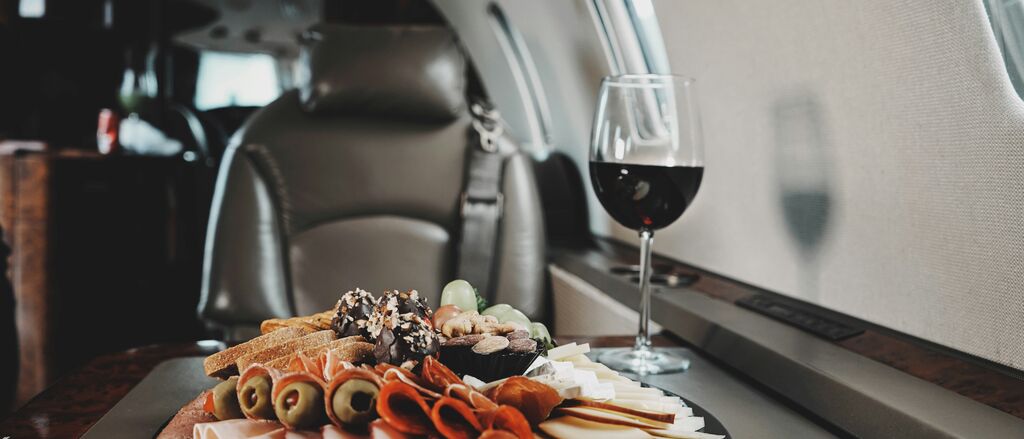
Inside a flight kitchen: where your airline food really comes from
Monday, September 21, 2026
Ever bitten into a slightly rubbery in-flight meal and wondered who on earth made this, and when? That’s a very fair question. That tray in front of you wasn't thrown together in a tiny galley an hour ago. It's the end product of a logistics operation that starts on the ground, sometimes a full day before you even board.
So where does airline food actually come from, what happens to it once you're done consuming it, and can you just skip the whole thing and bring your own? Let's go behind the scenes.
What actually happens before your meal reaches the trolley
Your in-flight meal is cooked, cooled, and sealed long before takeoff. It isn't prepared fresh in the air, no matter how it looks when it lands on your tray table. Airline catering teams work on a tight, reverse-engineered schedule: meals are cooked in bulk, rapidly chilled to keep them safe, then portioned into individual trays by hand or machine, depending on the dish.
From there, the trays are loaded into trolleys in a strict order, matching the exact meal count, special requests, and service sequence for that specific flight. Get the order wrong, and a flight attendant ends up rifling through an entire cart mid-service looking for the one vegetarian meal at the back. The trolleys are delivered to the aircraft hours before boarding even starts, kept chilled the whole way, and only heated once the flight is airborne. By the time a flight attendant hands you your meal, it's already been through more handling than most food you'll eat all week.
Inside an airline catering facility
These aren't restaurant kitchens. They're industrial-scale operations, some producing tens of thousands of meals a day for dozens of flights at once. A typical facility is split into zones: hot food preparation, cold preparation, tray assembly lines, and cold storage, all timed to feed one enormous loading schedule that can't afford to slip.
Companies like Gate Gourmet and dnata Catering run facilities like this at major airports around the world, often supplying meals to several airlines out of a single site. It's less an airline kitchen and more small-scale food factory, built entirely around precision and timing. The meal on your tray was likely never anywhere near the airline itself until the trolley was wheeled onto the plane.
Why airplane food tastes different at 35,000 feet
Here's the part that sounds made up but isn't: the air in a pressurised cabin is dry, and cabin pressure itself dulls your sense of taste, particularly for salty and sweet flavours. Some studies suggest your ability to taste sweetness can drop by as much as 30% in the air.
That's part of why airline meals are often seasoned more heavily than food you'd eat on the ground. Caterers are compensating for taste buds that are, quite literally, not working at full capacity up there. It's also why tomato juice, of all things, tends to taste noticeably better mid-flight than it ever does at sea level. Turns out altitude plays a role in flavour, and it’s more important than you’d expect.
What happens to food that doesn't get eaten
This is the part passengers rarely think about: if your meal goes untouched and stays sealed, it usually doesn't get reused. On many international flights, untouched food and packaging are treated as a biosecurity risk and destroyed after landing, to avoid pests or diseases crossing borders in food waste. Even on domestic routes, food safety rules mean that once a tray has left catering, it typically isn't served again.
So that perfectly good, still-sealed bread roll you didn't touch? In most cases, it's gone the moment the plane lands. Airlines have been working to reduce this waste in recent years, but for now, "leftovers" mostly isn't a concept that exists in airline catering.
Can you bring your own food on a plane?
Good news: in most cases, yes. Solid food is generally allowed through airport security and in the cabin, whether it's a sandwich, snacks, or a full packed lunch. The restrictions mostly come down to liquids and gels: anything over 100ml in your hand luggage, think soups, yoghurts, or spreadable foods, runs into the same rules as any other liquid. Checked luggage is far more forgiving if you're planning to bring something bulkier or messier.
When the meal's the least of your problems
All that precision timing behind your meal is genuinely impressive, right up until a delay or cancellation throws the whole schedule out anyway, and you're left waiting at the gate with nothing but the vending machine. If that happens to you, it's worth checking whether you're entitled to compensation. Check out our compensation checker on Flight Delayed UK, it only takes a couple of minutes and tells you exactly what you're owed, you can have the right to up to £520.



Did you like this content ?
Thanks you made our day!
Help us be better!
Well received, thanks!