Can airport scanners detect drugs?
Friday, January 16, 2026
Have you ever wondered, when going through security, what the security agents are looking for, and what can they actually see on the scanners? Can they detect drugs? Can they see the insides of our bodies when scanning us? Can they see hidden compartments in our bags?
We are here to clear up any uncertainties revolving around these questions. To be clear, we are not condoning you to bring these items on board a plane, this is not a guide to bypass security checks. This blog was written for informational purposes only!
Before jumping into what airports actually look for, and what they can see on their scanners, let’s break down how these scanners actually work.
How do airport scanners work?
There are two elements being scanned once you go through security. You are scanned, and your luggage is scanned. Both you and your luggage go through different types of scanners and checks.
Body scanners
There are three types of body scanners that exist, and the one you get depends on where you are in the world, and which technology they favour.
- Millimeter wave scanners: these scanners use non-ionizing electromagnetic radiation to detect items under someone’s clothes, or potentially hidden in body cavities. If a suspicious object is detected, the area of the body that conceals the object will be lit up in orange, and further checks will be performed on the person. If nothing suspicious is detected, then the screen will flash green. These are the most popular types of scanners, as their privacy settings are highest - they do not show an image of individual bodies.
- X-ray based scanners: There are two types under this category: Backscatter x-ray scanners, and transmission x-ray scanners. These are still used in certain countries, but are starting to be phased out due to the radiation risks and privacy concerns.
- Backscatter x-ray scanners use a low dose of radiation primarily to detect hidden objects under clothes, in shoes, or in human cavities.
- Transmission x-ray scanners use higher doses of radiation to pass through your body, travelling between scanners. This type of x-ray targets not only hidden objects under clothes, but also within your body. This is the type of x-ray that is used to detect ingested items such as gems or drugs within the body. Yes, these scanners can detect drugs in your bum.
- Infrared thermal conductivity scanners: This scanner is used to detect temperature differences under the surface of your clothing, as opposed to radiation. This type of scanner relies on the ability of contraband to heat or cool the surface of your clothing faster than your skin surface. Warm air is used to heat up the surface of your clothes, and if there is a hidden object, it would cool or heat up your clothes faster, thereby exposing its location. This type of scanner is generally less used than radiation-based scanners. Certain US airports use this type of scanner, but it is not as popular as the options above.
Luggage scanners
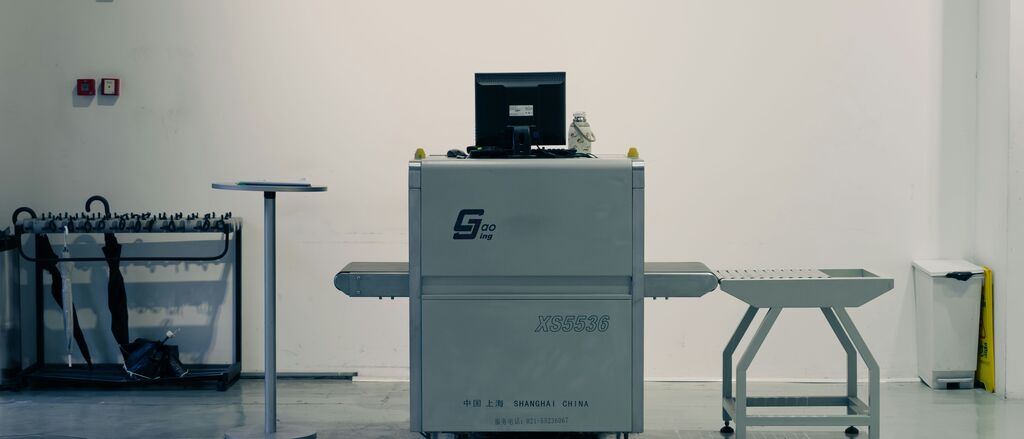
Luggage scanners are x-ray machines that build a picture of the inside of your bag. There are two detectors on either side of the machine, one emitting the wave of x-rays and the other receiving it. The rays that pass through your bag will carry less energy than those that don’t encounter anything on their path.
There are two sets of detectors in the machine: one that records low-energy x-rays, and the other collects only high-energy x-rays. By comparing the density of rays from both detectors, the machine can build an image of the position of objects in your bag, as well as a rough idea of what they are made of.
- Organic materials fall under the lighter colours, and these include paper, food, or explosives. Lower density materials often show up on the scanners as lighter colours (orange, yellow).
- Lower-energy rays represent more dense materials, and often show up on the scanner as darker colours. Blue or green represents denser materials such as glass or metal.
Therefore, if you have weapons, such as a knife or gun, the scanners will pick up on the denser material and showcase the outline of them in blue or green on the screen, likely leading to your bag being searched.
These scanners can therefore see all items in your bag, including hidden compartments that you may have.
Can airport scanners detect drugs?
Full-body scanners
Yes, airport scanners can detect drugs. The full-body scanners are mainly used for this purpose if you have ingested any drugs, if you are hiding them under your clothes, or in your body cavities. Bag scanners will detect them too, although that is not their primary job.
Bag scanners
Bag scanners are used to check for any substances that are weapons, or can be used as weapons. These scanners cannot differentiate types of pills. They can see pills in your bag, but don’t necessarily know what type of pill these are. It is always recommended to keep these pills in their original packaging, so that security officers can easily tell that you are not carrying illicit substances. You may have experienced a moment when your bag was swabbed, or even your hands. This is not to detect the presence of drugs, but rather to test for explosive residue.
Sniffer dogs
If the scanners are not enough to discourage people from bringing drugs on planes, most airports also have sniffer dogs. These dogs are trained to detect any number of illicit substances, but primarily drugs, explosives, live animals, animal manure, ivory, organic matter, blood, money, or certain electronic devices.
Customs and border patrol
You will likely not be stopped at security for carrying drugs, but rather at the border control and customs, after you have picked up your bags. These agents employ different tactics:
- They check your departing country,
- They check your travel history
- They use random checks
- They will use sniffer dogs
Can I take prescription medication on the plane?
Yes, you can take your prescription medication on board a plane. However, there are certain rules to follow for different types of medication.
Different countries have their own rules about whether you need proof the medicine is yours, for medication that does not include controlled drugs. However, it is always recommended that you have a letter from your medical practitioner or a prescription to prove that these belong to you.
- You will always need a prescription for medication that is in liquid form that exceeds 100ml, or for syringes.
- It is always recommended to keep your necessary medicine in your carry-on luggage should you need it during your journey.
- For medication that includes controlled drugs (such as opiates or opioids), you need to have a prescription proving that these are for a medical condition that you have, or you may risk having them confiscated at the border.
- For certain prescription medication, you may need to check if they fall under the Opium Act. You may need to apply for a medical passport in some of these cases, which allows you to travel abroad with these. The Schengen area has its own medical certificate allowing you to travel anywhere in the area on only one certificate. Different countries outside this area have different requirements, so it is always important to check with your medical practitioner before you decide to travel with your medication.
What items can trigger false positives on airport scanners?
It happens regularly that certain people are asked to have their bag checked, or have an extra pat-down, or swabbed for substances even though they are not carrying anything illicit. These are called false positives, and certain substances trigger these on scanners.
Airport scanners usually search for two main chemical compounds: glycerin and nitrates. These are primary components in many explosives. Although scanners are very effective in identifying these compounds, they can unfortunately be found in everyday items, which leads to many false positives. Indeed, these chemicals can be found in moisturisers, creams, shampoos, soaps, or certain prescription medication. Other possible false positives include lawn fertilisers, accelerants or recent contact with fireworks.
Furthermore, false positives during the body scan can be triggered by thick sweaters, forgotten items in pockets, buttons, clothing folds, or sweat. Technology has greatly evolved, and these airport scanners are now much better at identifying real threats from false ones, but it may still slip up sometimes.
What other illicit items can airport scanners detect?
As previously mentioned, airport scanners are very sensitive, and can see many hidden items in your bags and on your person. Here’s a couple of items that would be flagged for extra inspection:
- Explosives: Any explosive substance, or substance with the potential for exploding will be flagged and probably removed. These include gunpowder, fireworks, flares, or lighter fluid. These can be detected by airport scanners, primarily by their consistency and their density. This may seem obvious to some, but big quantities are confiscated at security every year.
- Flammables: Any flammable substance is prohibited and confiscated at airport security. Flammables include both more explicitly flammable items such as lighter fluid, or everyday household items such as spray deodorant, paint solvents, or matches. This also includes alcohols above 140 proof (70%), unless purchased and properly packed at duty free.
- Firearms or weapons: Again, this may seem like an obvious answer, but there are a surprising amount of people that travel with weapons in their carry-on bags. These include loaded firearms or knives. Under no circumstances are you allowed (as a civilian) to travel with firearms in your carry-on luggage. Only authorised and declared personnel is allowed this, such as authorised law enforcement. Those who wish to travel with firearms must put them in their check-in luggage unloaded, in a specialised hardcase. They must declare this at the check-in counter. Knives can be checked into luggage undeclared, but cannot be carried in carry-on luggage. Ammunition must also be checked and declared in the proper fashion, never to be carried on board the cabin. These can be recognised by their shape on airport scanners.
- Electronic devices with lithium batteries: These pose high risks of catching on fire when checked into luggage. Restrictions are tightening surrounding these batteries when added to carry-on luggage as well, as they have been prone to catching on fire in the cabin of planes too. These are often flagged at security when not properly packed in electronic devices. Often, portable batteries for phones are confiscated due to the risk they may pose when on a plane.
- Excessive amounts of powder: In certain countries (notably the United States), security officers will stop and inspect most people with more than 350ml of powdered substances in their bags.
- Liquids: The most commonly confiscated items are liquids that exceed the 100ml limit. These can include anything from gels, to creams, to water bottles, toothpaste, lotion, perfumes, and many more.
- Sharp objects: Sharp objects are a commonly confiscated type of item. This can include many things, from knives (as mentioned above), to scissors, razors, boxcutters, or corkscrews. These are easily recognisable on scanners, and thus often taken away.
Conclusion
Airport scanners have gotten very sophisticated over the years and therefore can detect most items stored in your bag. From clothes to pills and deodorant, not much gets past the scanners. If you are thinking of transporting illicit substances through airport scanners, beware that security will most probably see it.
Have you recently experienced a flight delay or cancellation?
Was your flight delayed by 3 hours or more, or cancelled less than 14 days before your departure date? We’ve got you covered! According to EU 261 regulations, you may be entitled to flight compensation of up to €600. Check your eligibility using Flight Delayed’s Claim Calculator!
We hope you found this informative, and we wish you safe travels!



Did you like this content ?
Thanks you made our day!
Help us be better!
Well received, thanks!