Types of power plugs: Overview of international electrical outlets
Thursday, May 7, 2026
Have you ever traveled to a country for the first time, only to realise that none of your chargers or devices fit the power sockets? It’s a common issue, as different countries use different plug types. Don’t worry, we’ve all been there. To help you avoid these unexpected surprises, we’ve created a handy overview of plugs used worldwide. Read on and be prepared!
Types of power plugs per country
Types of electrical plugs in Europe
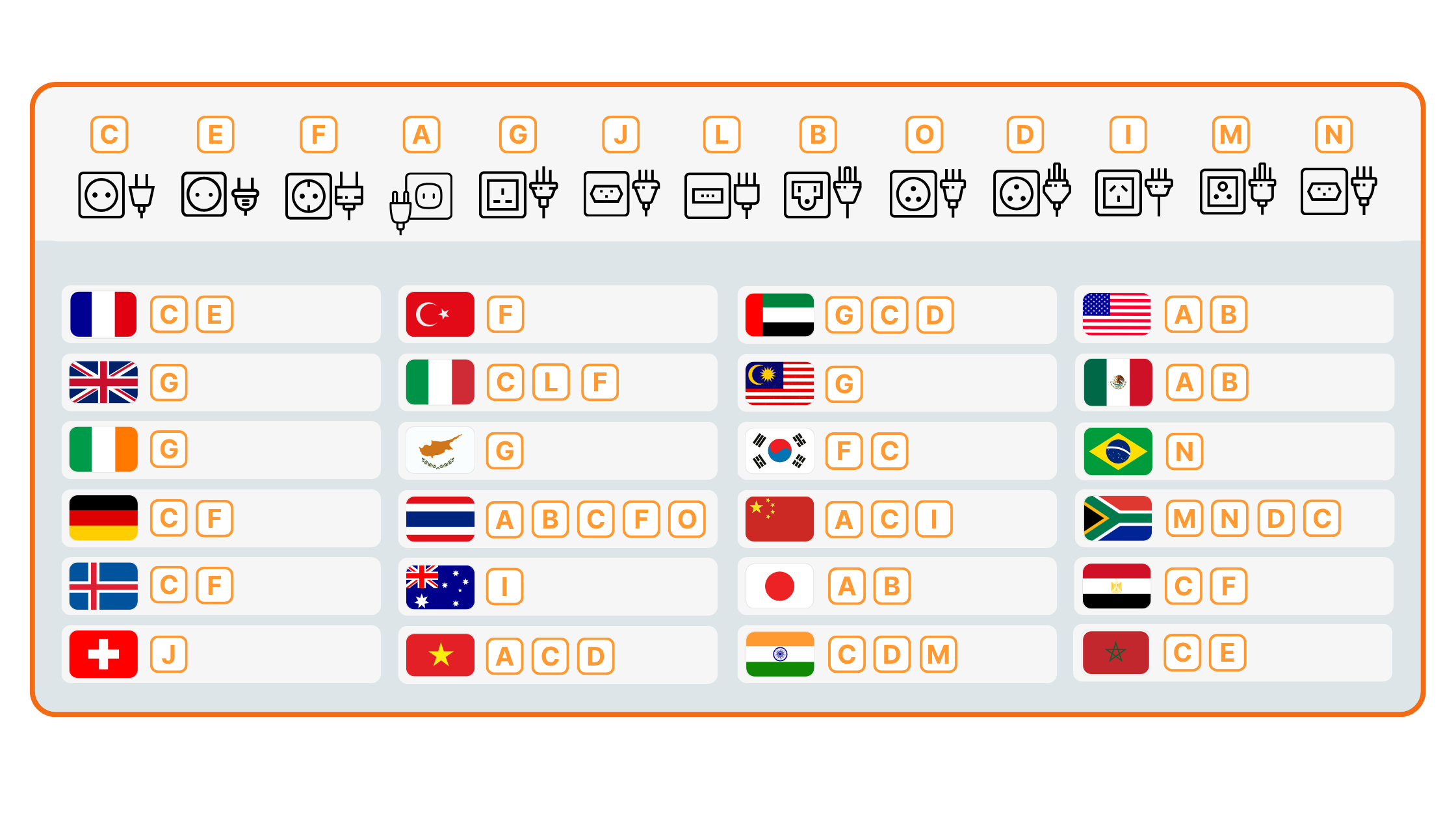
The standard EU plug type is Type C (also called Europlug). It features two round pins, and is used for low-power devices (220 - 240V). The C plug also fits into Type C, E, and F sockets.
For higher-power devices, Type F (also called Schuko), or Type E plugs and sockets are used. Those differ slightly from Type C, however can often be used interchangeably.
Remember though, whereas Type C plugs are usually compatible with Type E and F sockets, Types E and F plugs will not always fit into Type C sockets!
Below you can find more information on which plugs and sockets are used in popular destinations:
Type of plug in France
- France uses Type C and Type E plugs and sockets.
If you travel to France and have bigger devices with you, the best adapter to get is probably Type E, as it accommodates both ungrounded and grounded devices.
However, If you only have small devices, an adapter to Type C should work just fine.
Types of plugs in the UK and the Commonwealth
- The United Kingdom as well as British Overseas Territories use plug Type G - characterized by three rectangular pins in a triangular pattern.
If you’re travelling to the UK (or British territory) you should get an adapter to Type G.
Plug type used in Ireland
- Similar to the United Kingdom, Ireland uses Type G electrical plugs and sockets.
For your trip to Ireland, you should get a Type G adapter.
Type of plugs in Germany
- Germany uses Type C and Type F (Schuko) plugs and sockets, just like most of Europe.
If you’re traveling to Germany from outside of Europe, it’s best to get the Type F travel adapter.
Type of plug in Iceland
- Iceland uses European style plug and socket Types C and F, Type F being the most common.
- Remember though, that Type C are also compatible with Type F sockets. However some Type F plugs will not fit into Type C sockets (mostly in the case of the narrow Type C sockets).
If you’re traveling to Iceland from outside of Europe, it’s best to get the Type F travel adapter.
Type of plug in Switzerland
- Switzerland uses plugs and outlets of Type J. It’s a 3-pin plug which is used almost exclusively in Switzerland and Liechtenstein.
- Good to know: Type C plugs (2-pin ‘European’ plugs) are also compatible with Type J sockets.
If you travel to Switzerland from outside of Europe, you should get a Type J electrical plug adapter.
What type of plug is used in Turkey?
- Turkey uses the same Type F power plugs and outlets as most of Europe.
For your travels to Turkey (if you’re coming from a country using a different type of plug) it is wise to get the Type F adapter.
What plug is used in Italy?
- Italy primarily uses Type C and Type L plugs and sockets. Type F (Schuko) plugs/outlets are also common.
- Type C and Type F plugs are the typical European plugs.
- Type L plugs feature 3 round prongs in a line. Across Europe, they are only used in Italy, however they can also be found in other countries worldwide: Chile, El Salvador, Uruguay, Libya, Tunisia, Ethiopia, Cuba, Syria and the Maldives.
When traveling to Italy, consider getting the Type L adapter. Although many places (especially more modern ones) accept Type C and Type F plugs, some places might require Type L plugs.
What plug sockets are used in Cyprus?
- Cyprus uses Type G electrical plugs and sockets, which are most commonly associated with the UK.
If you’re going to Cyprus and you use a different type of plug on a daily basis, you should get the Type G adapter.
Plug and socket types in Asia and Oceania
Type of plug used in Thailand
- Thailand uses power plugs and sockets (outlets) of Type A, Type B, Type C, Type F and Type O.
- Type C and Type F plugs are common European plugs (2 parallel pins).
- Type A plug has 2 parallel prongs.
- Type B plug has 2 flat parallel pins and one round earth pin.
- Type O plug has 3 pins arranged in a triangular shape. This plug is unique to Thailand.
If you’re travelling to Thailand, you will need an adapter for Type A and B plugs. Consider getting a universal adapter to make sure you encounter no troubles, especially if you’re travelling through the country and often change accommodation.
Type of plugs in Australia
- Australia uses Type I plugs, which have 3 flat pins arranged in a triangular pattern.
For your trip to Australia, you should take a Type I plug adapter with you.
Type of plug in Vietnam
- In Vietnam, Type A, Type C and Type D plugs and sockets are used.
- Type C is the widely used ‘Europlug’, Type A has 2 rectangular parallel prongs, Type D has 3 round prongs that create a triangular shape.
If you’re travelling to Vietnam, a universal adapter (that supports Types A, C and F) is probably the best idea. Different places might require different plugs.
Type of plug in Dubai
- United Arab Emirates primarily use Type G plugs and outlets (so called British style). However, Type C and Type D plugs are also common.
- Type C is the commonly used ‘European’ plug.
- Type D has 3 prongs arranged in a triangle pattern.
For your trip to Dubai it is best to have the Type G plug adapter (if necessary for your devices).
Type of plugs in Malaysia
- Malaysia uses Type G plugs - ones with 3 rectangular pins arranged in a triangular shape. This is the same type as used in the United Kingdom.
If your devices don’t have the Type G plug, you should get a Type G travel adapter.
Type of plugs in South Korea
- South Korea uses Type F (Schuko) and Type C (Europlug) plugs and sockets.
- Type F is predominant, but Type C works as well.
For your trip to South Korea, it’s best to get a Type F (Schuko) travel adapter (if your devices don’t already have that plug type).
Type of plugs in China
- In China, power plugs and outlets of Type A, Type C and Type I are used.
- Type C is the typical ‘Europlug’.
- Type A has 2 rectangular parallel pins.
- Type I has 3 rectangular pins arranged in the shape of an upside down triangle.
If you travel to China, the best choice might be to get a universal travel adapter (supporting Types A, C and I).
Type of power plug in Japan
- Japan uses Type A and Type B electrical plugs and sockets.
- Type A plug has 2 rectangular parallel pins.
- Type B has 2 parallel flat pins and a round earth pin below and in the center.
If you’re travelling to Japan, it’s best to get an adapter for both Type A and B. If you don’t want to purchase both or a universal one, Type A only adapter should cover you in most places.
Types of power plugs in India
- India uses Type C, Type D, and Type M power plugs and sockets (outlets).
- Type C (Europlug) is commonly used across Europe, whereas Type D and M are less common.
Because there are a few plug types used in India, consider getting a universal travel adapter.
Plug and outlet types used in The Americas
Types of power plugs used in the U.S.
- The United States uses power plugs of Type A and Type B.
- Type A plugs have 2 rectangular parallel prongs.
- Type B plugs have 2 flat parallel pins and one round earth pin.
If you’re travelling to the United States, you might want to consider getting a universal adapter that covers Type A and B plugs/outlets. Alternatively, you can get two separate ones.
Types of plugs in Mexico
- Similar to the United States, Mexico uses Type A and Type B plugs and sockets.
- Type A plug has 2 parallel prongs, rectangular.
- Type B plug has 2 rectangular parallel pins and one round earth pin.
For your trip to Mexico, you should get a universal adapter that covers Type A and B plugs/outlets, or two separate ones for each type.
What electrical plugs does Brazil use?
- Brazil uses Type N power plugs and outlets.
- Type N plugs are characterized by three round pins in a triangular (almost in line) pattern
If you’re travelling to Brazil, you need to get the Type N adapter.
Electrical plugs used in Africa
Types of power plugs in South Africa
- South Africa uses 4 different plug Types: Type M, Type N, Type D, and Type C (Europlug).
- Type M plug is the most commonly used one. It has 3 large round pins, arranged in a triangle shape.
- Type N plug is used in more modern buildings. It has 3 pins shaped in a triangular (almost-in-line) pattern.
- Type D plug has 3 large pins arranged in a triangular pattern.
- Type C plug (Europlug) with 2 parallel round pins can often be used with small electronics, however is not as common as the other types.
When travelling to South Africa, you will mostly need a Type M adapter – those outlets are most commonly found. However, if you want to be prepared for anything, and especially if you plan to move around the country, we recommend getting a universal adapter.
What type of power plug for Egypt?
- Egypt uses Type C and Type F (Schuko) plugs and outlets.
- Both types are commonly used across Europe.
If you’re travelling to Egypt, you should get Type C and F adapters, however Type F only should generally suffice.
Types of electrical plugs used in Morocco
- Morocco uses Type C and Type E plugs and sockets.
- Both Type C (Europlug) and Type E plugs are common plug types in Europe.
If you’re going to Morocco and your devices don’t have the desired plug types, you should get either a Type C or Type E travel adapter.
And there you have it. Hopefully now you know which electrical plug types you need to prepare and which sockets to expect for your next travels. And remember, if you’re unsure which adapter to get, a universal international one will do the trick. It might be a bit more expensive than your regular one-way adapter, but it will have you covered no matter where you travel next!
Did you know you can claim flight compensation for your delayed or cancelled flight?
That’s right, if you’ve experienced a flight delay of over 3 hours or a last minute cancellation, the EU261 regulation protects your right to flight compensation of up to €250, €400, or €600 – depending on the distance of your flight. If you’re unsure if your flight qualifies for compensation, check it with our Claim Calculator. All you need to do is fill out your flight information and our experts will inform you whether you can claim compensation.



Did you like this content ?
Thanks you made our day!
Help us be better!
Well received, thanks!