The most dangerous airports in the world
Friday, August 28, 2026
Only around 50 pilots worldwide are certified to land at Bhutan's Paro Airport. That is a smaller group than most football squads. Paro sits in a deep Himalayan valley ringed by 18,000-foot peaks, and the runway stays invisible to pilots until the final two nautical miles of approach. But Paro is far from alone. Across the world, a handful of airports combine short runways, mountain terrain, extreme altitude, and minimal instrument guidance to push aircraft and pilots to their absolute limits. Here are ten of the most dangerous airports on earth, and what makes each one so extreme.
What makes an airport dangerous?
Not every challenging airport is dangerous for the same reason. The factors that make landings difficult tend to combine:
- Short runways that leave little room to stop or abort
- High altitude, where thin air reduces engine thrust and lift
- Mountainous terrain that limits approach paths and rules out go-arounds
- Unpredictable weather, including crosswinds, wind shear, and sudden fog
- No instrument landing systems, forcing pilots to rely entirely on visual cues
At the airports below, several of these factors occur at once. That is when standard airline training is no longer sufficient.
The 10 most dangerous airports in the world
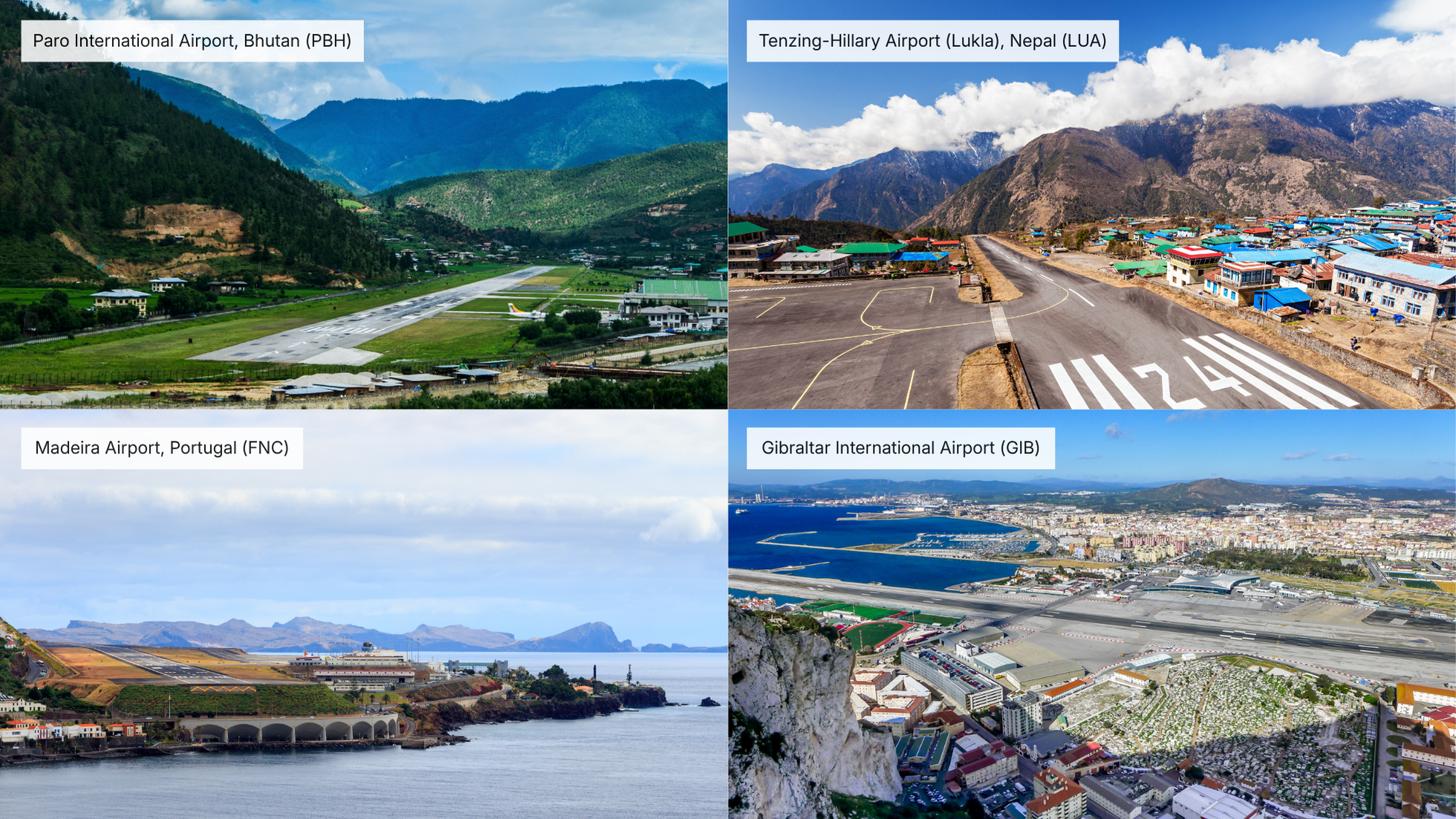
1. Paro International Airport, Bhutan (PBH)
Paro is Bhutan's only international airport. It sits at 7,332 feet above sea level in a narrow Himalayan valley, with surrounding peaks rising to 18,000 feet. Pilots cannot see the runway until the final one to two nautical miles of approach, compared to ten or more miles at most international airports.
There is no radar. No ILS. Pilots navigate the valley using a series of visual landmarks as checkpoints, executing a steep turn in the final moments before touchdown. Night landings are not permitted. Neither are operations in low visibility. The airport tries to complete all landings before noon, when temperatures are cooler and crosswinds less severe.
To qualify, pilots must hold an Airline Transport Pilot certificate, a minimum of 1,500 total flight hours, and 500 hours of mountain flying. They must then complete 30 supervised takeoffs and landings at Paro before operating unsupervised. Only two airlines, Drukair and Bhutan Airlines, are authorized to fly there. (Source: Simple Flying, 2026)
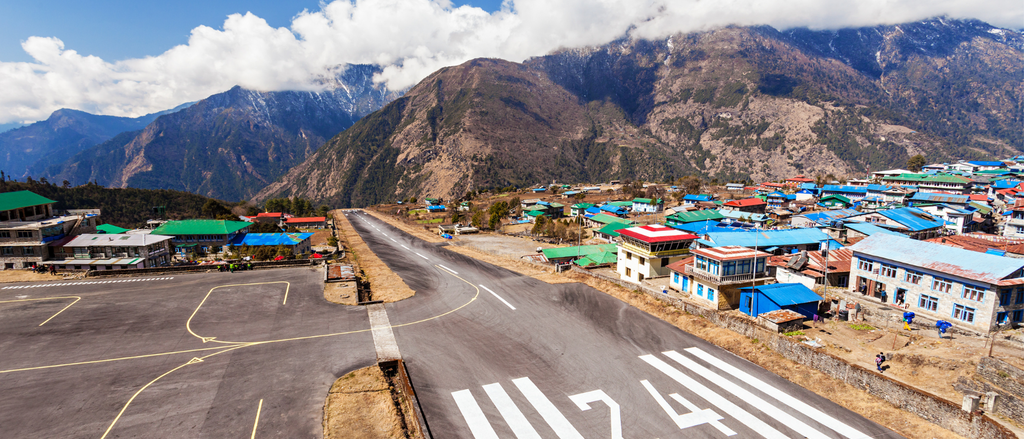
2. Tenzing-Hillary Airport (Lukla), Nepal (LUA)
Lukla is the starting point for most Everest Base Camp treks. For pilots, it is one of the most unforgiving runways on earth.
The runway is 527 metres long, less than a third of a typical commercial airport. It sits at 9,334 feet above sea level, where engines generate less thrust and wings produce less lift. The runway slopes uphill at an 11.7% gradient to help aircraft slow down. At the far end: a sheer drop into the valley below. At the near end: a mountain face.
There is no ILS, no radar. A go-around is not an option once a pilot commits to landing. Nepal's Civil Aviation Authority requires pilots to have completed at least 100 short-takeoff-and-landing (STOL) flights, more than one year of STOL experience in Nepal, and ten training flights at Lukla with a certified instructor before operating independently. (Source: Simple Flying, 2026)
3. Courchevel Altiport, France (CVF)
Courchevel serves one of the French Alps' most exclusive ski resorts. Its runway is 537 metres long with an 18.6% downward gradient — steeper than any public road in the United States.
Pilots land uphill and take off downhill. At the far end of the runway, the slope drops into a cliff. There are no instrument approach procedures. A go-around is not possible once the approach is committed. Only licensed mountain pilots with specific Courchevel training are permitted to operate there.
4. Juancho E. Yrausquin Airport, Saba Island (SAB)
The runway at Saba is 400 metres long, making it the shortest commercial runway in the world. It sits on a rocky plateau with jagged terrain on one side and cliffs falling into the Caribbean Sea at either end. Jet aircraft are not permitted. Even for small propeller aircraft, operations require a waiver from the Dutch Caribbean aviation authority.
5. Gustaf III Airport, St Barts (SBH)
St Barts' only airport has a 640-metre runway that descends from a hillside directly onto the beach. The approach drops sharply over a hilltop before levelling out just above the sand. Pilots require special certification to land here. Passengers tend to grip their armrests throughout.
6. Madeira Airport, Portugal (FNC)
Madeira Airport, officially named after Cristiano Ronaldo, has a runway extension built on 180 concrete pillars above the Atlantic Ocean. The approach to Runway 05 requires a 180-degree visual turn because straight-in instrument approaches are physically blocked by surrounding terrain.
Portugal's civil aviation authority classifies Madeira as a Category C airport, its highest difficulty rating. Pilots must complete specific simulator training and ride in the jump seat for takeoffs and landings before being cleared to fly there independently. Around 80% of diversions happen when winds exceed the safety limit by just 3 knots. (Source: Simple Flying, 2026)
7. Aspen-Pitkin County Airport, USA (ASE)
Aspen is widely considered North America's most technically demanding commercial airport. It sits at 7,820 feet above sea level in a mountain valley, with surrounding terrain rising to 14,000 feet. Aircraft must land on Runway 15 and depart from Runway 33 — the opposite direction on the same runway — because mountains to the south make a standard circuit impossible.
The FAA requires special training for all flight crews serving Aspen. As of 2025, only SkyWest Airlines crews hold the required certification for commercial operations. At peak times, opposite-direction operations run continuously, with departing aircraft clearing the approach path just as arriving aircraft turn onto final. (Source: Simple Flying, NBAA)
8. London City Airport, UK (LCY)
Most airports use a standard approach angle of around 3 degrees. London City operates at 5.5 degrees, nearly twice the norm, because the runway sits in Docklands with Canary Wharf's towers rising immediately to the north. At just 1,508 metres, the runway is also significantly shorter than those at major commercial airports.
Aircraft types, operators, and individual pilots all require separate certification to use LCY. On a first visit, UK CAA rules require pilots to fly an ILS approach, execute a go-around, and then land with at least 3,000 metres of visibility and a 1,500-foot cloud base. (Source: Simple Flying, 2026)
9. Princess Juliana Airport, St Maarten (SXM)
Princess Juliana is famous for one thing: arriving jets clearing Maho Beach at around 30 feet before touching down. The runway begins immediately past the sand, so pilots maintain a steep approach over the ocean right up to the threshold. The airport gained wider notoriety in 2017 when a bystander was killed by jet blast from a departing aircraft.
10. Gibraltar International Airport (GIB)
Gibraltar's runway crosses Winston Churchill Avenue, the territory's main road. Barriers close more than 15 times a day to stop traffic for landings and departures. But the road crossing is not the primary challenge. Strong turbulence and wind shear from airflow around the Rock of Gibraltar make approaches consistently demanding, particularly in winter when go-arounds are common.
How do the airports compare?
| Airport | Country | Runway length | Elevation | Special certification |
|---|---|---|---|---|
| Paro International | Bhutan | 2,265 m (7,431 ft) | 7,332 ft | Yes (~50 pilots worldwide) |
| Tenzing-Hillary (Lukla) | Nepal | 527 m (1,729 ft) | 9,334 ft | Yes (STOL only) |
| Courchevel Altiport | France | 537 m (1,762 ft) | 6,588 ft | Yes |
| Juancho E. Yrausquin | Saba Island | 400 m (1,312 ft) | 60 ft | Yes (no jets permitted) |
| Gustaf III | St Barts | 640 m (2,100 ft) | 49 ft | Yes |
| Madeira | Portugal | 2,781 m (9,124 ft) | 190 ft | Yes (Category C) |
| Aspen-Pitkin County | USA | 2,134 m (7,004 ft) | 7,820 ft | Yes (FAA) |
| London City | UK | 1,508 m (4,948 ft) | 19 ft | Yes (steep approach cert) |
| Princess Juliana | St Maarten | 2,300 m (7,546 ft) | 9 ft | No |
| Gibraltar International | Gibraltar | 1,829 m (6,000 ft) | 15 ft | No |
What qualifies a pilot to land at these airports?
Standard airline training prepares pilots for routine operations. The airports above sit in a different category entirely. Regulators classify certain airports as Category C, requiring additional simulator training, supervised flights, and in some cases a minimum number of specialist flying hours before independent operations are permitted.
At Paro, the qualification process takes months. At Lukla, pilots need more than a year of STOL experience before flying in solo. At Aspen, only one regional carrier currently meets the FAA's requirements.
These certifications exist for a straightforward reason. When the margin for error is measured in seconds and metres, experience matters in ways that standard training does not cover.
Flying to a difficult airport and your flight was disrupted?
Airports with limited flight windows, unpredictable weather, and frequent diversions also come with a higher risk of delays and cancellations. If your flight arrived more than 3 hours late or was cancelled with less than 14 days' notice, you may be entitled to financial compensation under EU261.
Remember, in order for your flight to be covered by the regulation, it must have departed from a European airport or been operated by a European airline. Additionally, the airline must have been at fault for the disruption.
If you're unsure whether you can get compensation, check your eligibility with Flight Delayed and see if your disrupted flight qualifies for compensation.
Frequently asked questions
Which is the most dangerous airport in the world?
Paro International Airport in Bhutan is widely considered the most dangerous airport in the world. It is surrounded by Himalayan peaks reaching 18,000 feet, has no radar or instrument landing system, and only around 50 pilots worldwide are certified to land there. All operations must be completed in daylight and clear conditions.
What is the hardest airport to land at?
Paro in Bhutan and Tenzing-Hillary Airport in Nepal (Lukla) are consistently named the hardest airports to land at. Both require fully visual approaches through mountain terrain, offer no instrument guidance, and demand specialist certification that very few pilots hold globally.
What is the shortest commercial runway in the world?
Juancho E. Yrausquin Airport on Saba Island in the Dutch Caribbean has the world's shortest commercial runway, at just 400 metres. Only small propeller aircraft can operate there, and each flight requires a special waiver from the aviation authority.
Can passengers fly into Paro Airport?
Yes, but options are limited. Only Drukair and Bhutan Airlines are authorized to operate scheduled flights there. Flights run during daylight hours only, with no operations permitted in low visibility or during the monsoon season between June and August.
What is the steepest runway in the world?
Courchevel Altiport in the French Alps has one of the steepest runways in the world, with an 18.6% gradient. Pilots land uphill and take off downhill, with no option to go around once committed to the approach.
This article has been written with the assistance of AI, however, it has been fact-checked and edited by a member of our team of air passenger rights experts before publication



Did you like this content ?
Thanks you made our day!
Help us be better!
Well received, thanks!